.
 When a big story breaks about social media and kids, the headlines move fast, and the details get lost. So we sat down with the settlement itself, and we want to walk through what we found with you.
The document is a joint status report and settlement agreement filed in Massachusetts Superior Court, in the case brought by the Commonwealth against Meta Platforms and Instagram (Commonwealth of Massachusetts v. Meta Platforms, Inc., No. 2384CV02397-BLS1). Meta agreed to it without admitting wrongdoing. Everything below comes from reading that court document directly, and going to the source turns out to matter here in a way that is worth sharing.
Here is what the agreement actually requires. Meta must default teen users to two hours of use per day across its apps, tightening later to 60 minutes on any single app. It must hide the number of likes and reactions on teen accounts by default. It must turn off certain cosmetic filters for teens. And it must switch off push notifications during school hours, which the document defines as 8am to 3pm on weekdays. Crucially, a parent has to approve any change that makes these settings less strict.
Those are real guardrails, and we welcome them. But going to the source surfaced something a headline can miss, and it turns out to be a small lesson in media literacy itself.
Take the rule on cosmetic filters. A quick headline might tell you Meta is banning face filters for teens. The actual document is far narrower. It only covers filters that reshape a face in ways that “cannot be achieved without cosmetic surgery or extreme makeup,” things like a surgically slimmed jaw or artificially enlarged eyes. It specifically carves out filters that merely smooth skin, on the reasoning that ordinary makeup can do the same thing. So the filters that quietly tell a teenager their skin should look flawless? Those are still allowed. This is exactly the kind of gap between what a message claims and what it actually delivers that we ask students to notice.
That skill, reading closely and asking what a message really says, is the thing no settlement can install. Every fix in this agreement is a limit set from the outside. A time cap tells a young person how long they can scroll. Even the school-hours notification blackout has an edge to it: the quiet only lasts until 3pm, so the pull moves to the hours kids are at home, and the lost sleep and unfinished homework still follow them back to school the next morning. None of it teaches them why the feed is built to hold their attention, or how to tell the difference between “face filters are banned” and “some face filters are banned.” Settings do not travel from app to app. Reading skills do.
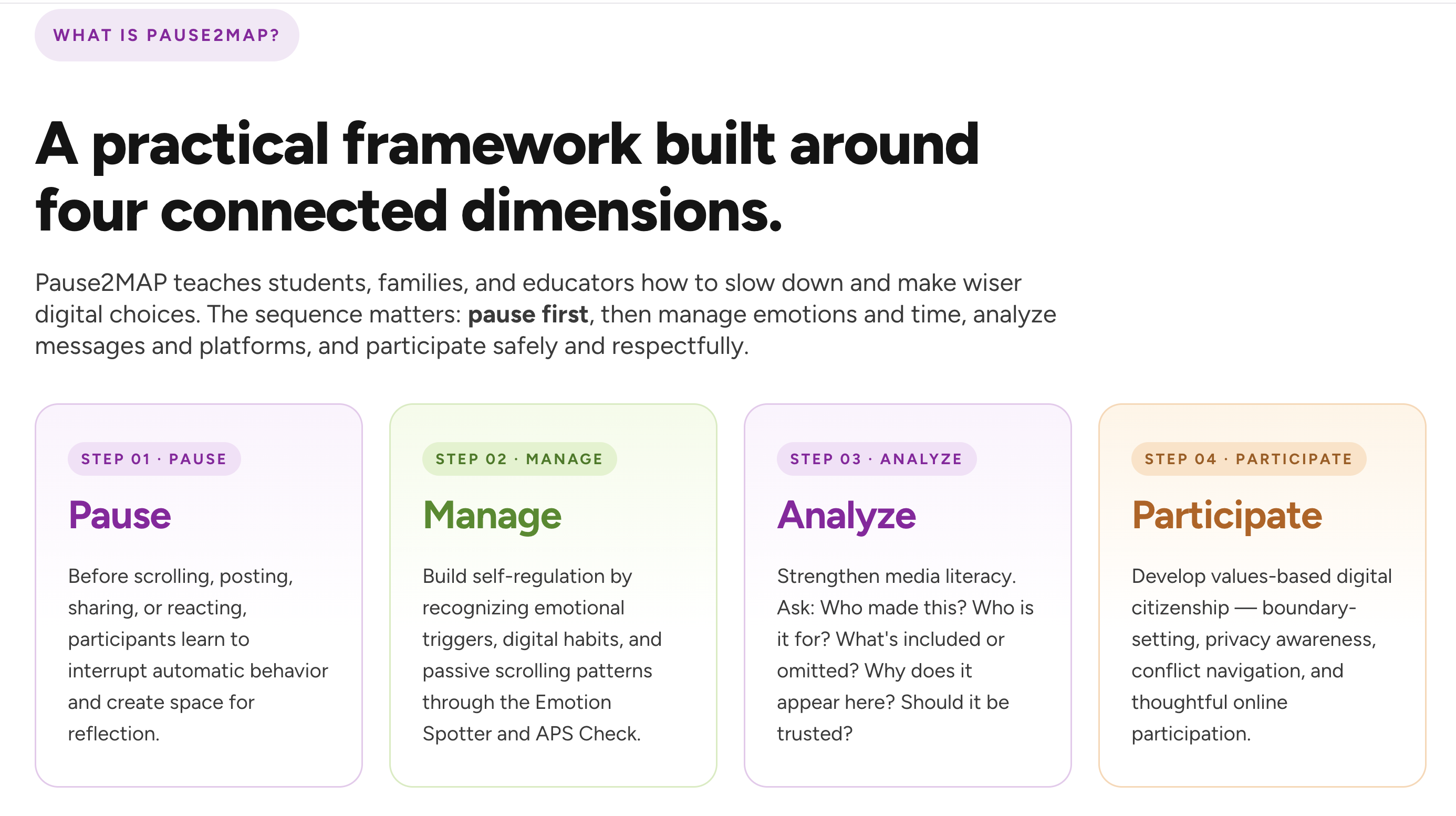
Here is what that looks like in practice. Picture a filter that reshapes a teenager’s face before they have even decided to post, giving them a narrower nose and a sharper jaw. Our Pause2MAP framework asks them to pause before reacting, then to analyze: Who made this filter? What is it telling me my face should look like? Who profits when I believe that? Those questions turn a passive moment into an active one. The court can ban that filter by default, and it did. Only the young person can learn to see what it was doing and to notice that the smoothing filter sitting right next to it was left untouched.
That is the work Pause2MAP was built for. It helps students, families, and educators slow down and make wiser choices online: to pause, to manage their emotions and habits, to analyze who made a message and why, and to participate with care.
One note for the parents and teachers reading this. The concern behind this case is real, and researchers continue to document links between heavy social media use and anxiety, loneliness, and depression among young people. We raise it not to alarm anyone, but to make the case for acting early, before harm becomes a crisis.
The law has set the floor, and these guardrails were long overdue. What it can't do is build the judgment a young person carries into every app, every feed, and every post. That judgment grows from a habit any of us can practice together, with the young people in our lives: go to the source and ask what it really says. Rules keep kids safer. Skills help them think clearly. Young people need both.
Comments(0)