Case Study | MediaEd Insights | Digital Ubuntu Edition | July 2026
Written by Caroline Makumbe
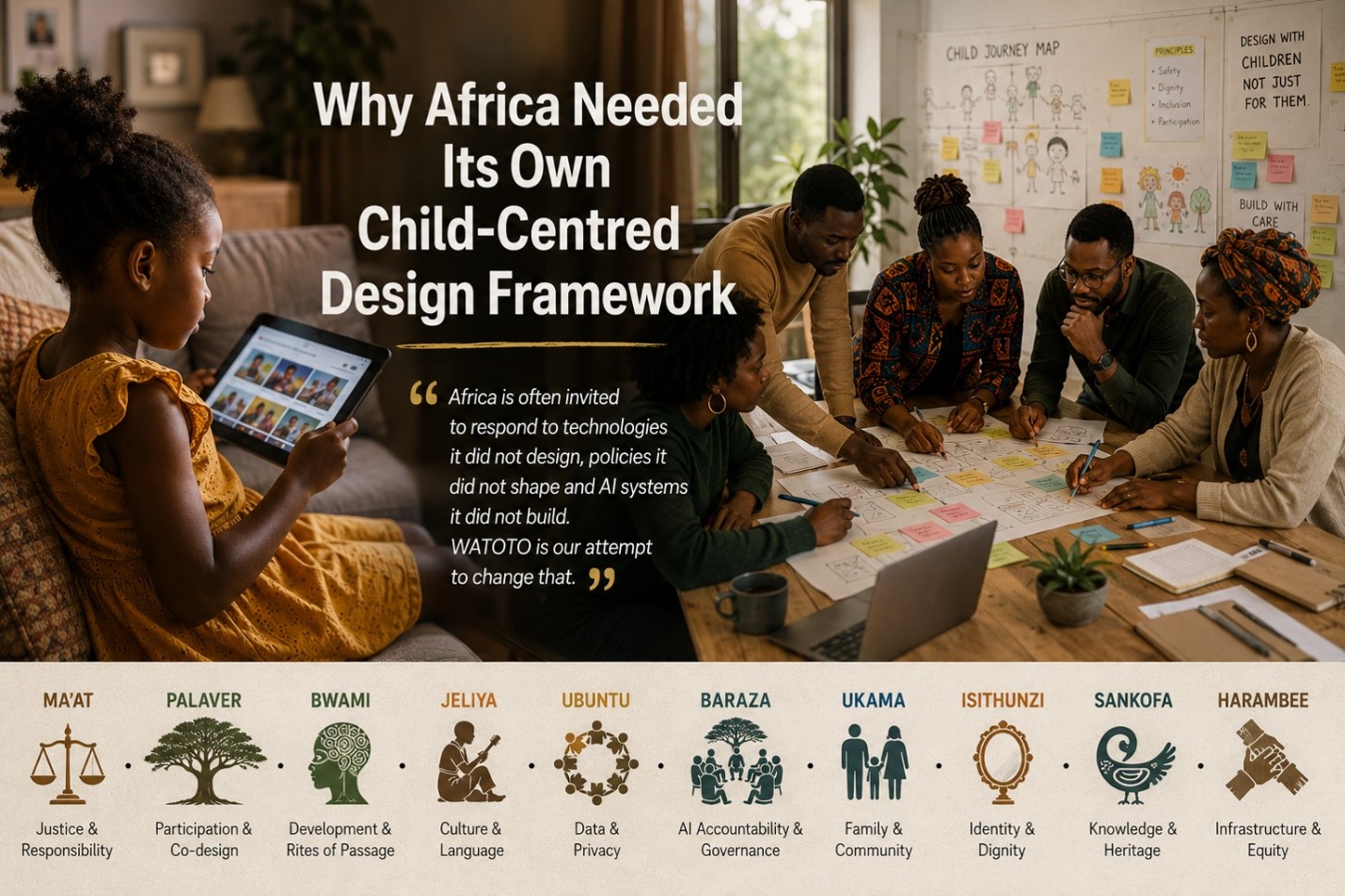
She was six years old.
It was an ordinary afternoon, the kind that blends into countless others. She curled up on the couch, opened YouTube Kids and began watching cartoons. Every so often she laughed, called out to the adults nearby to watch with her, or proudly announced that she had discovered a new favourite video.
She was not looking for anything dangerous.
She was not searching for inappropriate content.
She was simply being a child.
Then she clicked…
It was not a reckless click. It was not even curiosity. It was simply the next video that popped up.
Within seconds, the carefully curated world of YouTube Kids disappeared. She had somehow found herself on YouTube, where one of the first videos promoted the "No Panty Challenge."
She did not understand what she was seeing.
The adults did.
The video disappeared almost as quickly as it had appeared. But one question lingered long after the screen had gone dark.
How did a child get here in the first place?
That question sits at the heart of almost every conversation about children's digital lives today. Around the world, governments are responding to online harms with proposals to ban children from social media, strengthen age assurance or restrict access to digital platforms. These are important conversations, and there is no one-size-fits-all solution to protecting children online.
But they all begin from the same assumption.
That the child must adapt.
But what if we asked a different question?
What if, instead of asking whether children are ready for technology, we asked whether technology is ready for children?
For more than two decades, I have worked alongside governments, technology companies, civil society organisations and international institutions to advance children's rights in the digital age. I have contributed to policy debates, safeguarding initiatives and digital governance across Africa. Yet, one uncomfortable truth has become impossible to ignore.
Even those of us who dedicate our careers to protecting children have very little influence over the products children use every day.
We can advocate.
We can educate.
We can regulate.
But we cannot redesign products we did not build.
That challenge is becoming increasingly urgent.
Africa remains the youngest continent on earth. Nearly 70% of the population of sub-Saharan Africa is under the age of 30, and millions of children are coming online for the first time through smartphones that are rapidly becoming their primary gateway to education, entertainment and social connection. At the same time, artificial intelligence is transforming how children learn, play and interact with the world.
Yet the overwhelming majority of these technologies are imagined, designed and governed far from the communities in which African children live.
Africa is often invited to respond to technologies it did not design, policies it did not shape and AI systems it did not build.
WATOTO Child-Centred Design Framework is our attempt to change that.
For too long, Africa has contributed stories, evidence and lived experience to global conversations about technology while importing the frameworks used to understand and govern it. The WATOTO Framework represents something different. It is not Africa adapting global thinking. It is Africa contributing original thinking to the global field of child-centred technology design. At its heart, the WATOTO Framework begins with a proposition rarely found in technology development:
Childhood is cultural. “It takes a village to raise a child.”
Children do not simply grow through biological stages. They develop within relationships, communities, languages, histories and values. Yet much of today's technology assumes a universal childhood, one shaped by the experiences of the Global North. African childhood tells a different story.
Many children share devices with parents and siblings. Connectivity is expensive and unreliable. Multiple languages are spoken in a single household. Grandparents, extended family and neighbours actively participate in raising children. Knowledge is often transmitted through storytelling rather than text. Identity is formed collectively rather than individually.
These are not constraints to design around.
They are realities to design from.
This is why every standard within the WATOTO Framework is named after an African philosophy, governance tradition or knowledge system.
These names are not symbolic.
They are engineering principles.
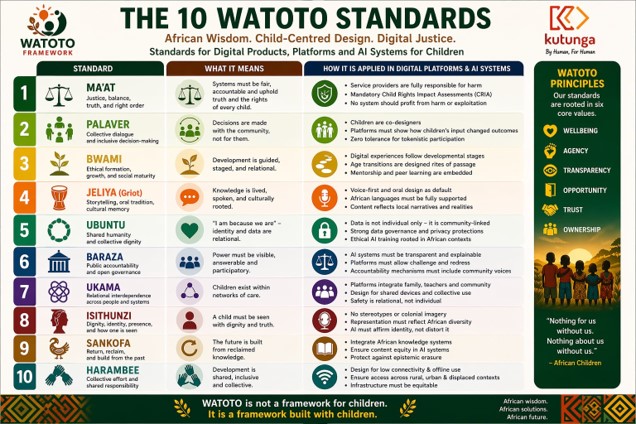
MA'AT, inspired by the Ancient Egyptian principles of justice, truth and right order, establishes the foundation of the framework. It shifts responsibility away from children and parents and places it where it belongs, with service providers. Before asking, what a child should have done differently, WATOTO asks what the product should have done differently.
Child safety becomes a design responsibility, not simply a parenting challenge or regulatory obligation.
PALAVER, drawn from the West African tradition of collective dialogue, reminds us that children are not passive recipients of technology. They have the right to shape the products that shape their lives. Genuine child participation is not a consultation exercise completed at the end of a project; it is a design methodology that rejects tokenism and values children's lived experiences as legitimate expertise.
BWAMI, inspired by traditions of ethical formation and social maturity in the Democratic Republic of the Congo, challenges one of technology's biggest assumptions, that age alone determines readiness. African childhood has long recognised growth as a relational journey supported by families and communities. WATOTO translates this into digital rites of passage, where children gradually acquire new digital rights alongside new responsibilities appropriate to their stage of development.
With JELIYA, the wisdom of West Africa's griots becomes a design principle. Storytelling, oral traditions and linguistic diversity are not cultural ornaments added during localisation. They become primary design inputs. Products should speak African languages, reflect African stories and respect the cultural realities that shape children's identities.
The philosophy of UBUNTU transforms how we think about children's data. If "I am because we are," then a child's data cannot simply be treated as a commercial asset. It is an extension of personhood and community. Privacy therefore becomes more than individual consent; it becomes a question of collective dignity, transparency and digital sovereignty.
As AI becomes increasingly embedded in children's lives, BARAZA offers an African model of governance. Across East Africa, the baraza has long been a space where communities gather to deliberate, question authority and make collective decisions. WATOTO applies this philosophy to AI, arguing that AI systems affecting children should never operate as opaque black boxes. They should be transparent, accountable and subject to community oversight.
UKAMA, a Shona philosophy of relational interdependence, reminds us that children are never isolated users. They exist within families, peer groups, schools and communities. Technology should strengthen these relationships rather than weaken them, recognising that supporting caregivers is itself a child safety intervention.
Through ISITHUNZI, WATOTO addresses one of AI's most overlooked challenges: representation. African children deserve to encounter themselves reflected with dignity, cultural pride and authenticity. Identity-positive design is not simply an inclusion strategy; it is a safety requirement. Children should never learn to see themselves through distorted mirrors created by biased datasets or inherited colonial narratives.
SANKOFA, the Akan philosophy of returning to reclaim what is valuable from the past, reminds us that African knowledge systems are not relics to preserve but living sources of innovation. African histories, languages and ways of knowing should be treated as primary design inputs rather than supplementary accommodations. Epistemic justice means ensuring that African children encounter their own cultures as valuable, visible and digitally present.
Finally, HARAMBEE, Kenya's enduring tradition of collective effort, grounds innovation in the realities of the continent. A child cannot meaningfully participate in the digital world if a product assumes unlimited connectivity, constant electricity or unlimited data. Offline-first architecture, shared-device functionality and connectivity justice are not technical conveniences. They are child rights issues.
Together, these ten standards transform African philosophies into practical product design, engineering and AI governance principles.
Ubuntu becomes data governance.
Baraza becomes AI accountability.
Palaver becomes participatory design.
Harambee becomes infrastructure justice.
African knowledge is not positioned outside technology. It becomes part of how technology is imagined, built and governed.
This is why the WATOTO Framework is not simply another online safety framework. It is an African contribution to global knowledge. It does not reject existing approaches to Safety-by-Design, children's rights or responsible AI. It expands them by introducing perspectives that have too often been absent from global conversations. It reminds us that there is no universal child, no universal childhood and no universal pathway to designing safe technologies.
The debate about social media bans illustrates this perfectly. Restricting children's access may reduce certain harms, but bans alone cannot solve problems created through poor design. If we continue building technologies that place commercial incentives ahead of children's wellbeing, future generations will inherit the same risks, regardless of the age at which they are allowed online.
We cannot regulate our way out of poor design.
We cannot educate children out of unsafe systems.
And we cannot ask parents to carry responsibilities that rightly belong to those who design and deploy digital technologies.
The question is no longer whether children belong online.
They already do.
The real question is whether the technologies we build deserve children.
I began this article with the story of a six-year-old.
Perhaps you imagined she lived somewhere else.
Perhaps you assumed she was a child from another country or another research study.
She was not.
She is not a child from the Global North.
She is my daughter…
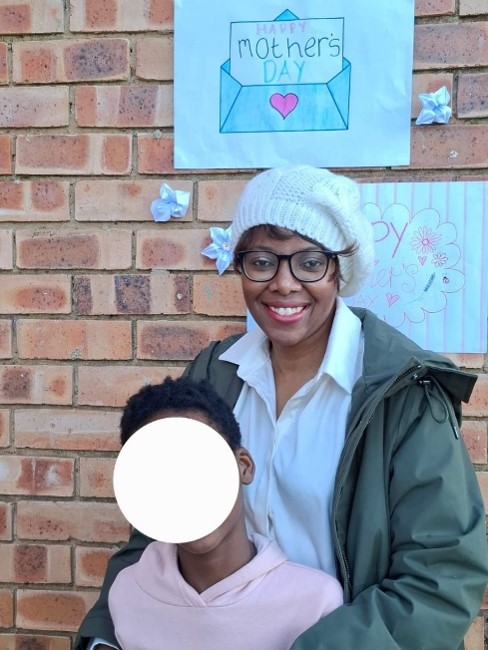
That single click fundamentally changed how I understood child online safety. It also mirrored the experiences of my colleague and partner, Jennifer Kaberi, whose own teenage children were navigating a digital world that too often expected them to adapt to products never designed with African children in mind.
The WATOTO Framework was born from those shared experiences.
Not from a policy workshop!
Not from an academic exercise!
But from the lived realities of two African mothers who realised that OUR children deserved more than protection after harm had occurred.
They deserved technology designed around them from the very beginning. Perhaps that is the WATOTO Framework's greatest contribution.
It is not Africa asking for a seat at someone else's table.
NO!!!
It is Africa bringing its own table. Built on justice, dialogue, dignity, relationship, identity, collective wisdom and shared responsibility. And in so doing, offering the world not simply another framework, but another way of imagining what child-centred technology can become.
 Caroline Makumbe is the CEO and Co-Founder of Kutunga Design Academy & Innovation Lab, where she leads the development of African approaches to child-centred, safe and responsible technology design.
She is also the Founder and Director of CAROLMAKS Voice, advancing the wellbeing, participation and leadership of emerging adults (18–25), and the writer of Letters to My Gen Alpha, where she reflects on parenting, childhood and technology.
With over 23 years of experience in child rights, digital policy and innovation across Africa, Caroline's work is inspired by her own Gen Alpha children and their everyday interactions with technology, driving her commitment to shaping safer digital futures for children.
MediaEd Insights - June 2026 - AI: Educator Perspectives
Opening Essay: Digital Ubuntu: African Philosophy, AI, and the Future of How We Learn by Aurra Kawanzaruwa
Case Study: The Unhurried Child in a High Speed World by Tsitsi M Mutendi
Curriculum Review: The Katunga WATOTO Framework by Caroline Makumbe
Research Synthesis: The Ubuntu Operating System by Jennifer Kaberi
Comments(0)