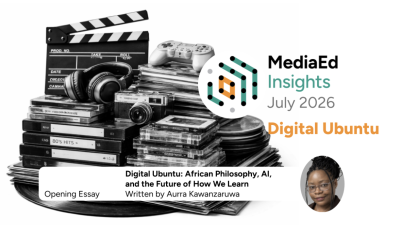
Opening Essay | MediaEd Insights | Digital Ubuntu Edition | July 2026
Written by Aurra Kawanzaruwa
The machines are already teaching our children. This is the philosophy that can teach the machines.
 If you're raising a child, you're probably a little overwhelmed. That's fair. There's so much noise, so much conflicting advice, arriving faster than any of us can reasonably process. Around the world, the response has started to converge on a single instinct. Restrict. Raise the age. Keep them out. A phone ban in one country, a new age limit in another, a law working its way through parliament somewhere else. I get it, and the harms that drive it are real. But the question we keep asking - whether our children are ready for this technology - may be the wrong one. The better question, running quietly through everything you're about to read, is whether the technology is ready for our children. That reframing didn't come from Silicon Valley. It came from Africa.
Long before the server or the algorithm, this continent had a theory of how a person forms. Not in a textbook, but in the way strangers at a fire will take your hands and correct them until the sadza (a traditional corn meal dish) is right, in the way a whole community gathers to witness one of its own becoming someone new. Knowledge was never a possession. It was tended, and passed between people, and found its shape through relationship. The Nguni put it into words. Umuntu ngumuntu ngabantu. A person is a person through other persons. In time, that entire theory of the self came to be carried in a single word. Ubuntu. I am because you are.
It's more radical than it sounds. It says intelligence is not something that happens inside one skull, that a person is a learning system and the community does the teaching. One of our oldest ideas - and suddenly one of the most modern in the world - because the most powerful learning machines ever built now work the same way. A model doesn't think the way one mind thinks. It learns from the collective, from millions of voices and corrections, growing more capable not through solitary genius but through exposure to the full range of human experience. It becomes intelligent the way Ubuntu always said we do. Through each other.
I don't think this is a coincidence to note once and set aside. I think it's an invitation, and it's why I've spent the last 2 years writing a book about it. I call the idea Digital Ubuntu - a title inspired by Yonty Friesem's Digital Empathy.
Digital Ubuntu is not people collaborating online. It is an African philosophy of how we learn, offered to a world now teaching its children through machines it does not fully understand.
The distance between our children and the digital world is not, at root, about skills. It's about language, about whether a child has a philosophy deep enough to understand and question and shape the thing they already live inside. They're not waiting outside technology to be admitted. They're in it, forming who they are within environments nobody built for the work of growing up. What they lack is a mother tongue for the digital age. Ubuntu is that mother tongue. Digital Ubuntu is the decision to turn to it on purpose.
What follows is not three articles side by side. It's one argument, made by three of the most serious minds on this question anywhere, in the only way an argument about collective intelligence honestly can be made. Together.
Tsitsi Mutendi, who runs the largest Montessori school in Zimbabwe, asks whether we can prepare a child for artificial intelligence without sacrificing what makes the child human. She is not theorising from a distance. She is with children every day. Her answer is a sentence I cannot shake. Technology must remain a tool, never the teacher. She shows what it looks like to raise a child who asks not can I post this, but should I. Not will this go viral, but will this build or break someone. And she names a quiet danger, that we have begun to measure childhood the way we measure an economy, in speed and output, when the unhurried child, the one given time to wonder and fail and belong, is not falling behind at all. Read her, and you will never look at your child's boredom the same way again.
Caroline Makumbe opens with a six-year-old who taps one wrong video and tumbles out of the safe world of children's cartoons into something no child should see. You will assume the girl lives far from her. She is Caroline's daughter. Out of that moment comes the WATOTO Framework, the first African-centred design framework for children: ten engineering standards, each named for an African philosophy. Ubuntu becomes a new way to hold a child's data. Kenya's Harambee becomes a demand that products work offline, on the phones African families actually share. Her closing line is the one I want every reader to carry. Africa is not asking for a seat at someone else's table. Africa is bringing its own.
Jennifer Kaberi names the assumption underneath every children's platform. We treat a child as a node. A lone account, one exhausted parent doing the work a whole community once did. But the safety circle was never one person. It was a web. We kept the node and we threw away the web. Then she reads digital childhood through the anthropology of the rite of passage and finds three phases we simply never built: the leaving, the threshold, and the return, and shows that a platform unlocking silently on a birthday is a child crossing into a new world with no elder holding the perimeter and no cohort crossing beside them. What she builds from there will rearrange how you think about a birthday.
There's an old habit in how the world talks about African thought. It arrives as decoration, a warm proverb before the real frameworks, all built elsewhere, get down to business. What you're about to read is not decoration. From Harare to Nairobi, these thinkers are handing the world original architecture for a problem no society has yet solved. Most of our technology ethics still runs on a single inherited assumption, the lone individual and the rights that fence them off from everyone else. Ubuntu begins somewhere else, from relationship and shared wellbeing, and when you begin there you arrive at braver questions. That difference is the gift.
So I'll say it plainly. Digital Ubuntu has something precise and urgent to say about the machines we're now raising our children inside. Tsitsi shows it in a classroom. Caroline builds it into an architecture. Jennifer traces it through the deep structure of childhood itself. Three voices, one fire. I only ask that you read them the way this continent has always known that anything worth understanding must finally be understood. Not alone. Together.
.png)
Aurra Kawanzaruwa is a digital strategist, educator, and ecosystem builder. She is the Director of Digital Strategy & Business Development at the Media Education Lab.
Aurra is also the founder of AfriDigital and the Africa Is Digital Summit, and the author of the forthcoming book Digital Ubuntu: African Philosophy, Artificial Intelligence, and the Future of How We Learn.
MediaEd Insights - July 2026 - Digital Ubuntu Edition
Opening Essay: Digital Ubuntu: African Philosophy, AI, and the Future of How We Learn by Aurra Kawanzaruwa
Case Study: The Unhurried Child in a High Speed World by Tsitsi M Mutendi
Curriculum Review: The Katunga WATOTO Framework by Caroline Makumbe
Research Synthesis: The Ubuntu Operating System by Jennifer Kaberi
Comments(0)