Part of my daily work at the Lab is reviewing webinar recordings and pulling out insights that surface along the way, especially during the Q&A. I believe that some of the most important conversations are the ones we have when we are not "performing" for an audience. That was the case with the "More Than Deepfakes" webinar led by Scott Spicer - Media Outreach Librarian for the University of Minnesota Libraries and author of the book, "Student-Created Media: Designing Research, Learning, and Skill-Building Experiences" (ALA Editions, 2022) - where one thread caught my attention because I have not really heard it picked up elsewhere.
Scott was walking through a generative AI media literacy resource he is building, and he made a point worth sitting with. The research right now suggests people believe video deepfakes less than they believe text. That sounds reassuring. He did not let it stay that way.
"As the research gets better, what people are allowed to understand as a deepfake becomes harder to discern. And when that becomes the case, then you come into a place where people's faith in audiovisual gets eroded, and then you move into a liar's dividend, where folks in power can say 'I didn't do that.' Folks in courtrooms can say 'I didn't do that. That's fake.'"
We have spent years afraid of the wrong half of this problem. Almost everything written about deepfakes runs on one fear, that we will be deceived, that a convincing fake will trick us into believing something false. But the risk Scott pointed at is the mirror image. It is not only that we start believing lies. It is that we stop being able to believe the truth, and that the people who need us to doubt the truth are the ones who gain.
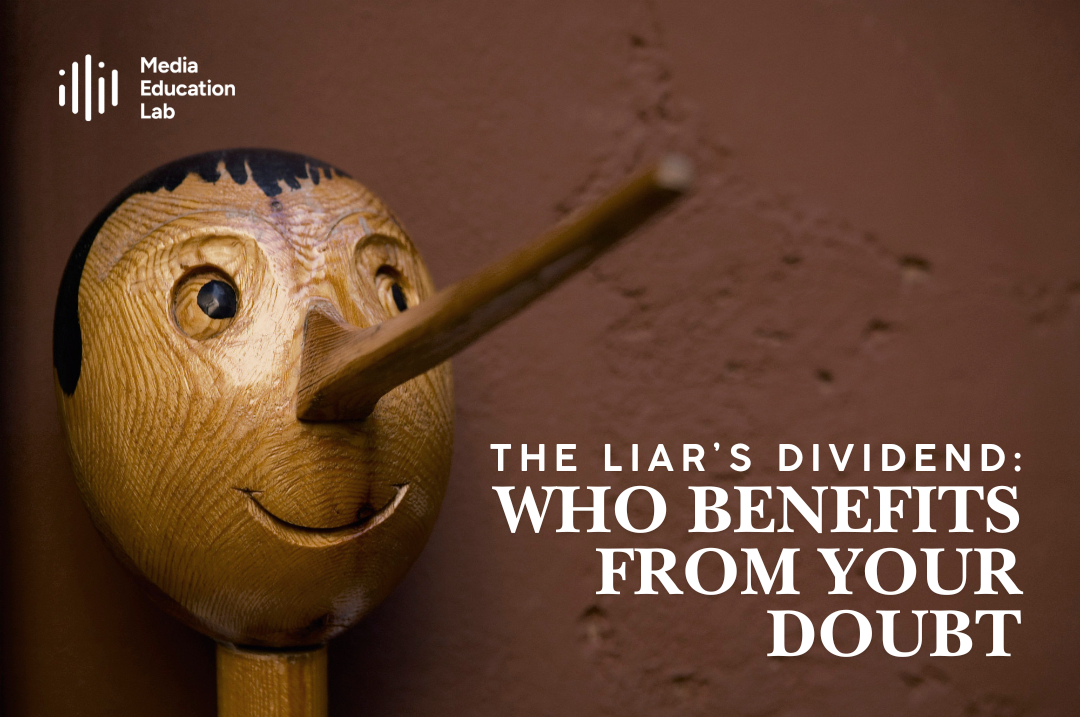
The phrase is not Scott's own. Legal scholars Bobby Chesney and Danielle Citron named the liar's dividend [Chesney and Citron, California Law Review, 2019]. The logic is simple. The more the public learns that video can be faked, the more a liar gains, because now the liar has cover, and can simply deny the footage and let the doubt do the work that used to require an actual defense.
The threat is not to truth so much as to accountability: The deepfake panic is about being fooled. This is about something that costs more. Once "that's AI" is a plausible thing to say about anything, real evidence loses its grip. A person caught on camera no longer has to prove the recording is fake. They only need enough people to wonder. And in that wondering, the weight shifts off the powerful, who used to have to explain themselves, onto everyone else, who now has to prove what they plainly saw.
The sharpest moment did not come from the slides. It came from the room. A participant raised the two killings that have marked recent years in Minnesota, George Floyd and the killing of Renée Good, and asked why they had landed so differently in public feeling. Part of it, Scott agreed, was the footage. The video of George Floyd left nothing to argue with, and it moved people because there was no gap to slip a doubt into. The footage in Good's case was less clear, and into that gap crept the question of whether it could have been AI, whether it could have been tampered with.
Notice what happened there. The simple fact that the technology exists, that we all know images can be manufactured, became a reason to doubt an image nobody had manufactured. A single real deepfake was never needed to poison the well. All it takes is for everyone to know that deepfakes are possible.
Scott gave the everyday version too. Is Mitch McConnell in a rehab facility? "If you don't like Mitch McConnell, he's not, it's generated. If you love Mitch McConnell, he's in the facility." Then the line that holds it together: "It's all social construction. It's a matter of where you're situated." We do not weigh the image. We weigh it from where we already stand, and the accusation of fakery becomes a tool for believing what we had already decided to believe.
This is where the usual conversation is too narrow. If we teach deepfake literacy as fake-spotting, training people to hunt for the tell, the blurred hand, the wrong shadow, we are preparing them for a fight the technology will win, because the tools will eventually get better than our eyes. The more useful skill is noticing when doubt itself is being used as a weapon, and asking who profits when a piece of evidence is suddenly called fake.
So the real question changes: not "can you tell what is real," but "can you hold on to the possibility of real evidence and real accountability in an atmosphere thick with plausible deniability." That is harder to teach, because it asks people to resist a comfortable feeling, the exhausted shrug of "you can't trust anything anymore." That exhaustion is exactly what the liar is counting on. Give up on the idea that anything can be verified, and the dividend is handed over without a fight.
Worth adding, from where much of the world sits: the powerful denying documented harm is not a coming danger but an old habit. The liar's dividend simply offers a more respectable version of it, one that no longer has to call the witnesses liars because it can call the camera a liar instead. That should worry everyone, but most of all in places where accountability was already fragile.
Earlier in the session, almost in passing, Scott called this a moment that is not only post-truth but post-audiovisual truth, where seeing is no longer believing. The deeper loss is not only our guard against lies. It is our shared ability to point at a thing that happened and agree, together, that it happened. A society that can no longer agree on what happened has no way left to hold anyone responsible for it.
None of this was on the agenda for the session. It came out of an unscripted exchange between a presenter and someone in the audience willing to ask a real question, which is exactly why these webinars are worth attending while they are happening and not only catching later. The recording of Scott's session is HERE, and our Events page is a good place to find other interesting webinars coming up.
Comments(0)