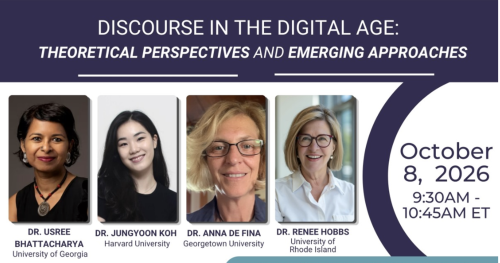
Discourse in the Digital Age, AAAL Webinar
I didn't think it would take 30 years. When I started working on media education, I figured we'd have it sorted out in a decade or so. Ha! But because media and technology keep changing, so media literacy keeps changing too. In my lifetime we've gone from visual literacy (hello, disposable cameras!) to information literacy, media literacy, digital literacy, news literacy, and now AI literacy. The names change, but the thread stays the same: literacy is the practice of meaning making through symbols in many forms. That was my starting point at a recent AAAL webinar on discourse in a mediated world. I got to share the virtual stage with applied linguists whose work really lit up my brain.
Here's what I wanted them to know. In most public school English classrooms, literacy practice still looks like this: read something, summarize it, write a properly formatted essay, and turn in the rough draft on Friday. And the audience? The teacher. Just the teacher.
Think about everything that leaves out: searching and curating, asking good questions, creating with images and sound, collaborating, reflecting on our emotional responses, understanding why just five platform companies hold so much power, and taking action as citizens.
The good news?
Choice is a powerful lever. Give students a theme you could drive a truck through, like "In Another's Shoes," and let them pick the format: a podcast, an infographic, an animation, a vlog. The teacher controls the process (small teams, real deadlines), and the work goes to a real audience. That's the dance between creative freedom and creative control.
Yes, it gets messy. I call it messy engagement. It happens because students actually care, and because projects can fail. The temptation is to over-scaffold: step one, put the eyes on; step two, put the nose on; step three, put the buttons on. Voilà! Thirty identical projects and not much thinking. Yikes.
I wanted the applied linguistics folks from AAAL to know more about the OECD PISA 2029 Media and AI Literacy Framework, and to see how it is relevant to their interests in digital discourse. It puts acting ethically and responsibly right at the center, surrounded by authors and audiences, messages and meanings, and representations and realities.
For me, this webinar was a chance to encounter valued scholars in an allied field that has tremendous connections to my work. I valued the comments and questions from an active audience on Zoom. I also valued Usree Battacharya's "resourceful improvisation" which felt like a kissing cousin of messy engagement, and her warning not to romanticize the hard work of improvising on the margins stayed with me. I also appreciated Jungyoon Koh and Anna de Fina's important insights when noting that online storytelling is increasingly about the storyteller and the audience, not the story. I'd add that every like, click, and share happens inside a business model where our attention is the product. That parasocial bond with your favorite influencer? It's a business relationship.
When it comes to issues of relationships and interactions, here's what's keeping me up at night. Lots of educators worry that AI will lead to cognitive offloading. I worry, too. So this semester I'm experimenting with a chatbot designed to make interpretation more effortful, not less. Can talking with a machine make students more mindful of their own meaning-making processes? I don't know yet. Stay tuned!
What do you think? Can a little productive messiness (with a chatbot partner) help learners activate intellectual curiosity and metacognition? I'd love to hear from you.
Comments(0)