In the West Bank, Educators Reframe Media Literacy as a Survival Skill for Life Under Conflict
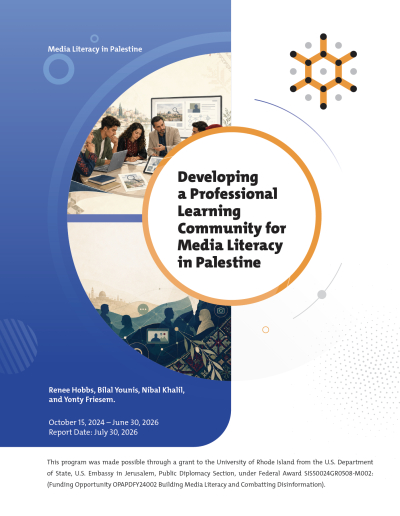 A 21-month U.S. State Department–funded program trained 17 Palestinian educators, reached 138 youth through youth workshops, and amplified young Palestinians’ media literacy creative work to reach 4.9 million views on Instagram.
KINGSTON, R.I. — July 30, 2026 — For young people growing up amid war in the West Bank, learning to question a viral image or a trending influencer is not a classroom exercise. It can be a matter of safety. That is the central finding of “Media Literacy: Critical Thinking for an AI World,” a new report from the Media Education Lab at the University of Rhode Island documenting a professional learning community that helped Palestinian educators teach youth to navigate propaganda, manipulated imagery, and AI-generated content in a time of conflict.
Across interviews and workshop observations, Palestinian educators consistently described media literacy in existential rather than academic terms, calling it “a survival skill,” “a civic competency,” and “a form of social resilience.” In an information environment saturated with emotionally charged political narratives, where conflict is monetized and even a reliable internet connection cannot be assumed, the program reframed media literacy from a media-studies elective into a defensive necessity.
The Program at a Glance
Running from October 2024 through June 2026, the program engaged 44 highly qualified Palestinian educators, 39 of whom began an online professional learning community; 17 completed the full 22 hours of instruction, an implementation plan, and the co-delivery of a youth workshop. Working in pairs through a “power of two” model, faculty adapted media literacy key concepts and instructional practices into nine distinct, culturally grounded teaching frameworks, from a “Stop, Think, Verify” golden rule to a focus on “conflict entrepreneurs” who profit from polarization.
Nine three-hour online workshops reached 138 West Bank youth ages 15–25, after war forced a pivot from in-person to online delivery in spring 2026. A social media campaign featuring young Palestinians’ creative work reached an additional 4,904,355 views on Instagram, and combined with the recruitment campaign, the program’s total documented reach exceeded 6.1 million.
Key Findings
The program’s most striking result was a shift in how educators understood their own work. “In the West Bank, media literacy is not an academic exercise: it is a survival skill,” said Renee Hobbs, Professor at the University of Rhode Island’s Harrington School of Communication and Media. “When young people can recognize the point of view embedded in every message, they gain agency over an information environment that is otherwise structured against them.” Palestinian faculty and youth alike came to treat critical media analysis as a condition of safety and social resilience rather than merely a media-studies elective.
The report also found that the approach worked best when it was hands-on and grounded in learners’ own world. “The evidence was unambiguous: participation rose with open questions, group work, and real Palestinian examples, and it fell during long lectures,” said Yonty Friesem, Associate Professor at Columbia College Chicago. “‘Learning by doing’ was not a slogan for these educators — it was the measured difference between a workshop that reached young people and one that did not.” Observers found engagement climbed with visual stimuli, group work, meme creation, and real-life Palestinian examples, and dropped during instructor-dominated lectures.
A central strand of the program helped faculty and students confront the “unreal realities” of AI-generated media. As deepfakes, edited images, and fabricated news erode the old equation between seeing and believing, participants learned to recognize the mechanics of manipulation, from generative-AI fabrications to the “conflict entrepreneurs” who profit from polarization and the electronic armies of bots and fake accounts that drive online debate. In their own words, one youth participant wrote that “AI today does not only produce images; it produces a parallel reality that deceives the senses,” capturing a theme that recurred across the youth-created work. A stance of curious skepticism is endemic to media literacy learning.
Those qualitative shifts were matched by measurable gains. Faculty participants significantly increased their knowledge, confidence, and skills, with the strongest growth in collaborating to advance media education (+1.24 on a 7-point scale) and using storytelling to promote civic participation (+1.02). They rated the program’s quality near the top of every scale, giving it a near-perfect recommendation score of 9.9 out of 10. Youth reported strong competencies as well: the highest-rated statement was that they could apply what they learned in life or at school (mean 4.20 of 5), and most agreed the program would positively affect their educational journey. An inductive analysis of 210 youth-created posts surfaced eight recurring themes, including media literacy as a personal “shield” and the discipline to “pause before you share.”
A distinctive finding was that trust, for Palestinian youth, is relational before it is institutional. Asked who actually influences them, young people most often named family, then friends and peers, then teachers. Social-media influencers are part of the mix, of course, but this pattern of respect for intimate trust networks has direct implications for how media literacy should be taught in the region.
Cultural Specificity and Local Leadership
Rather than importing a fixed curriculum, the program equipped Palestinian faculty to author their own. “Palestinian faculty did not import a curriculum. Instead, they built nine of their own, in Arabic, using what they learned in the program and applying it to the images and claims their students were already arguing about online,” said Bilal Younis, professor of education at Palestinian Technical University and local program lead. “Teaching verification as an act of responsibility toward neighbors living through the same events is what gave the work real ethical weight.” Working in pairs, faculty localized media literacy into nine culturally grounded frameworks, drawing on live issues, including Gaza war coverage, settler violence, fuel shortages, and the misuse of AI during war. In this program, students analyzed the very content they were already encountering and sharing as part of daily life.
The report argues that local leadership is the true foundation for a lasting media literacy network in Palestine. “This partnership demonstrated what Palestinian educators can accomplish when they are trusted to lead,” said Nibal Khalil, a program partner with the U.S. Embassy in Jerusalem. “The educators trained through this program are now positioned to carry media literacy forward across schools and universities, building an informed generation that can engage with all media critically and protect itself from manipulation.” Faculty participants strongly recommended that media literacy instructional practice be embedded in formal curricula and seek more ways to expand the work to more teachers and schools across Palestine.
What Comes Next
Though the U.S. State Department–funded project has concluded, the work continues. During the 2026–2027 academic year, Renee Hobbs and the Media Education Lab will collaborate independently with the Yatta Institute for Higher Education, empowering program educators to take leadership roles. They have already begun to support “Media Compass,” a youth-led initiative aiming to reach at least 300 Palestinian youth and train 15–20 peer facilitators across West Bank universities.
About the Program
The University of Rhode Island’s program, “Media Literacy: Critical Thinking for an AI World” was made possible through a grant to the University of Rhode Island from the U.S. Department of State, U.S. Embassy in Jerusalem, Public Diplomacy Section (Federal Award SIS50024GR0508-M002). The views expressed are those of the authors and do not necessarily reflect those of the U.S. Government.
Media Contact
Renee Hobbs
University of Rhode Island
# # #